

The short version
In 1920 a coal company sent private detectives to evict miners' families in Matewan, West Virginia, and the town's police chief, Sid Hatfield, stopped them in the street. Ten people died in the gunfight. Sid became a hero to the miners and a target for the company. Fourteen months later, on his way into a courthouse to answer a charge the union called a setup, he was shot dead with his deputy. Both were unarmed. The men who killed them said it was self-defense and were acquitted. Within weeks about ten thousand armed miners were marching on Logan County, and the federal government sent troops.
The story
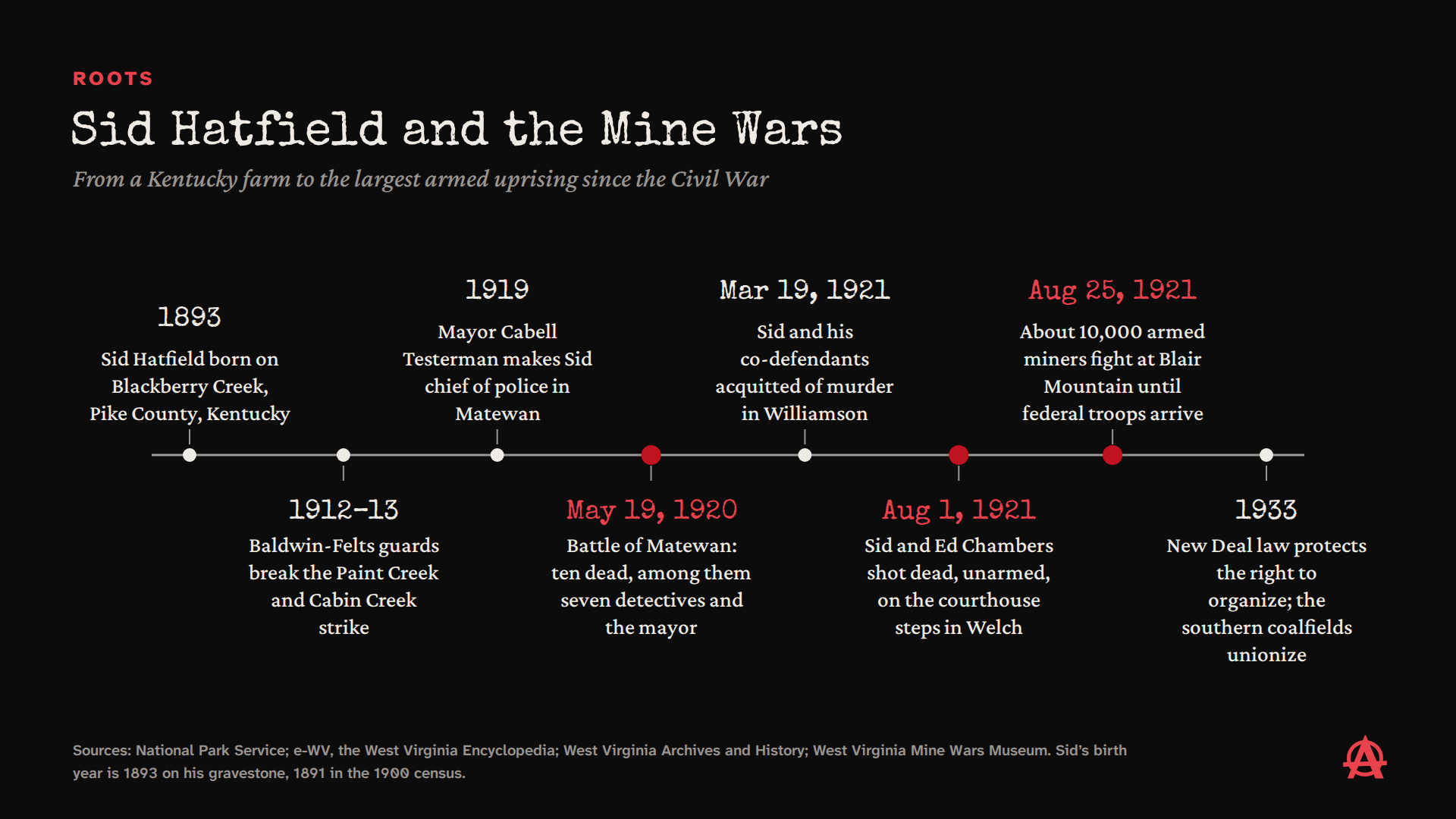
A blacksmith with a badge. William Sidney Hatfield was born on Blackberry Creek in Pike County, Kentucky, across the Tug Fork from West Virginia. His gravestone says 1893; the 1900 census says 1891. His parents were Jacob and Rebecca Hatfield, tenant farmers, and through his grandfather he was distant kin to Devil Anse, the feud patriarch. Sid worked the farm, went into the mines in his teens, and then spent several years as a blacksmith. People called him Smilin' Sid for the gold caps on his teeth, and Two-Gun Sid for reasons nobody wrote down. In 1919 Matewan's mayor, Cabell Testerman, made him chief of police. Some of the town's respectable people were surprised: Sid had a reputation for hard living and fighting. The miners were not surprised at all.
Company towns. In the southern West Virginia coalfields a miner usually lived in a house the company owned, was paid in scrip the company store accepted, and could be fired, and evicted, for joining the United Mine Workers. To keep the union out, operators hired the Baldwin-Felts Detective Agency, whose men had broken the Paint Creek and Cabin Creek strike of 1912–13 with machine guns and an armored train. In the spring of 1920 the UMWA organized Mingo County, and the companies began firing union miners and putting their families out on the road.
The bribe. The detectives wanted to station machine guns in Matewan. They offered Sid and the mayor substantial bribes to allow it, and both refused. (One later account puts the offer to the mayor at $200 for three guns on the roofs of stores.) This is the moment in the song: take no Baldwin-Felts bribes.
May 19, 1920. Twelve or thirteen agents, led by Albert and Lee Felts, came in by train and evicted families from the Stone Mountain Coal Company's camp. They had no legal authority to do it. In the afternoon, as they walked back to the depot for the five o'clock train, Sid stopped them and said he had warrants for their arrest. Albert Felts produced a warrant for Sid. Mayor Testerman read it and called it bogus. Armed miners were watching from the windows and doorways along Mate Street. Then someone fired.
Who fired first has never been settled. Sid said Albert Felts shot first. The coal operators said Sid put his revolver to Felts's head. The National Park Service and the West Virginia Mine Wars Museum decline to say. What is not disputed is the result: ten dead, seven of them detectives, including both Felts brothers, plus Mayor Testerman and two miners, Bob Mullins and Tot Tinsley. (One state archive count gives eleven.) Only six of the agents went home.
The trial. Sid married the mayor's widow, Jessie Testerman, on June 2, 1920, less than two weeks after the mayor died. The couple had been arrested in a hotel room the night before on a charge of "improper relations," and the Baldwin-Felts side went further and accused Sid of killing the mayor himself. No court ever found that. In January 1921 Sid and his co-defendants (twenty-two of them by the museum's count, seventeen by the state encyclopedia's) went on trial in Williamson for the murder of Albert Felts. On March 19 the jury acquitted them all. Sid was a hero across the coalfields; he even played himself in a short film for the union.
The courthouse steps. The companies found another way. Sid and his deputy and friend Ed Chambers were charged in McDowell County with conspiracy over the shooting-up of a mining camp at Mohawk. Mine guards said the two men led the attack; union leaders said it was a setup to lure them into a county the companies controlled. On August 1, 1921, the two couples walked up the steps of the McDowell County Courthouse in Welch. Neither man was armed. C. E. Lively, a Baldwin-Felts spy who had once posed as a union man in Matewan, opened fire along with two other agents, George "Buster" Pence and William Salters. Sid was hit four times. Ed Chambers was finished off with a bullet to the head while his wife watched. "Hatfield Was Unarmed, His Widow Asserts," the Baltimore Sun reported. The three agents claimed self-defense and were acquitted.
Blair Mountain. About three thousand people came to Sid's funeral. Miners called the shooting an assassination, and the governor refused their demands. On August 24 the march began. By the end of the month about ten thousand armed miners, many with red bandanas around their necks by later accounts, were fighting their way toward Logan and Mingo Counties along a ridge called Blair Mountain against an army of deputies and company guards. Private planes hired by the anti-union side dropped homemade bombs on them; the Army's planes, sent with General Billy Mitchell, flew reconnaissance. On September 2 about 2,100 federal troops arrived and the miners, many of them veterans who would not fire on U.S. soldiers, laid down their arms. Nearly a thousand were indicted. The union lost. The southern coalfields stayed largely non-union until 1933, when the New Deal guaranteed the right to organize.
What's remembered. In 1987 John Sayles made the film Matewan, with David Strathairn as Sid. In 2015 the West Virginia Mine Wars Museum opened on Mate Street. A 2019 marker in Matewan reads "Sid Hatfield: known for flashy gold teeth, 'Smilin' Sid' fought for miners in Battle of Matewan." Sid is buried in Buskirk Cemetery on the Kentucky side.
What the song changes, and why
- "Becky." No source calls Sid's mother Becky; the records say Rebecca. Becky is what a family would call her, and the song is told from the inside.
- "Bogus charges from the fight he justly won." The Welch charge wasn't for Matewan itself; it was a conspiracy charge over the Mohawk attack. The song folds them together, as the union did at the time: both were the companies' way of getting Sid into a courtroom.
- "Four bullets." Supported: one account says Sid was "pierced by four bullets," another says he was hit in the arm and three or four times in the chest.
- Who fired first is left out of the song on purpose. The explainer gives both accounts.
What it connects to
- Him Hold Ye In Your Mind. Robin Hood's oldest ballad tells his men to keep the sheriff in mind. Sid was the rare lawman who stood on the other side, and the companies treated him exactly the way the ballad's sheriff treats Robin. [Forthcoming in Storytime EP]
- Night of the Johnstown Flood. Both songs are about towns that belonged to someone else: a fishing club's dam above Johnstown, a coal company's houses in Matewan. In both, the people who held the power were never held to account. [Forthcoming in Storytime EP]
- I Hight Don Quixote. Parsons wrote that you cannot take another person's freedom without risking your own. The coal companies' private army is what that looks like in practice. [Forthcoming in Storytime EP]
- For more numbers-first work on empire and rebellion, see Star Wars Death Math.
Sources
- Hall, Alex. "The Story of William Sidney Hatfield of Pike, Kentucky." Appalachian Historian, December 30, 2025. https://appalachianhistorian.org/the-story-of-william-sidney-hatfield-of-pike-kentucky/
- National Park Service. "Matewan Massacre." West Virginia Mine Wars series, updated September 27, 2024. https://www.nps.gov/articles/000/matewan-massacre.htm
- National Park Service. "Introduction to the West Virginia Mine Wars" and "The March on Logan County." West Virginia Mine Wars series. https://www.nps.gov/articles/000/introduction-to-the-west-virginia-mine-wars.htm
- Raby, John. "Mine Wars: 'Matewan Massacre' a century ago embodied miners' struggles." Associated Press, in People's World, May 19, 2020. https://www.peoplesworld.org/article/mine-wars-matewan-massacre-a-century-ago-embodied-miners-struggles/
- West Virginia Archives and History. "May" (Matewan Massacre), Time Trail, West Virginia. https://archive.wvculture.org/history/timetrl/ttmay.html
- West Virginia Humanities Council. "Two-Gun Sid Hatfield" and "Assassinations of Sid Hatfield and Ed Chambers." e-WV: The West Virginia Encyclopedia, Mine Wars exhibit, sections 11 and 13. https://www.wvencyclopedia.org/exhibits/30/sections/550
- Savage, Lon. "Sid Hatfield" and "Matewan Massacre." e-WV: The West Virginia Encyclopedia. https://www.wvencyclopedia.org/entries/260
- West Virginia Mine Wars Museum. News and Labor History Archive: the Williamson trial (January 28, 2024) and "The Battle of Matewan: A Fight for Workers' Rights." https://wvminewars.org/news
- William G. Pomeroy Foundation. "Sid Hatfield." Legends and Lore marker, Matewan, 2019. https://www.wgpfoundation.org/historic-markers/sid-hatfield/
- Wikipedia. "Sid Hatfield," "Battle of Matewan," "Battle of Blair Mountain," "Baldwin-Felts Detective Agency," "C. E. Lively." Accessed October 2026.
- Sayles, John, dir. Matewan. Cinecom, 1987.