
The short version
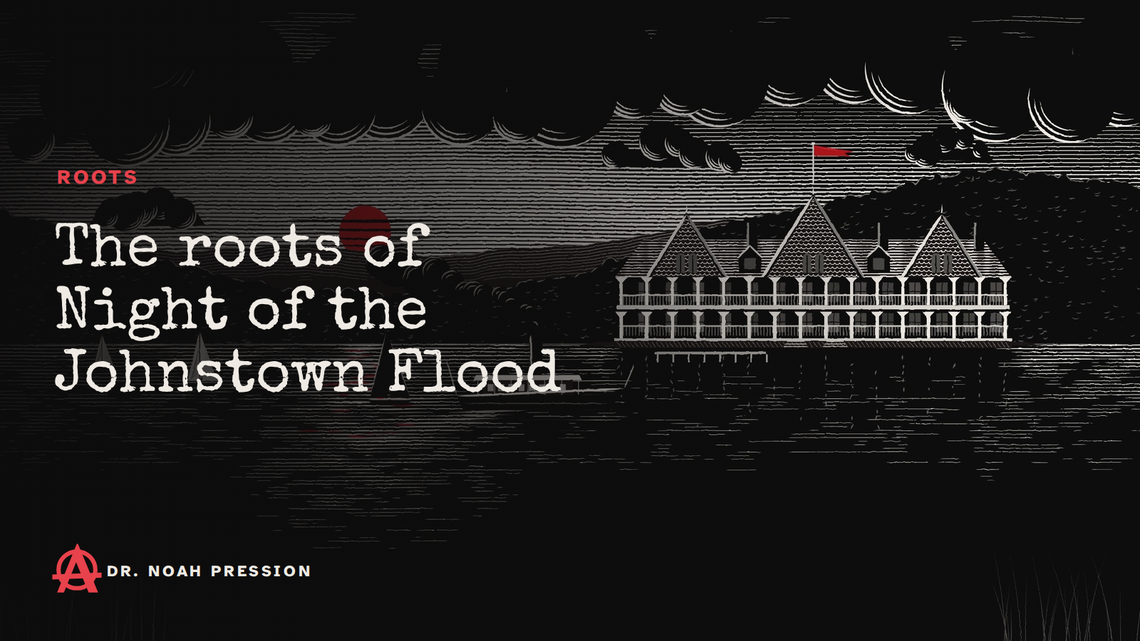
On May 31, 1889, after a night of record rain, the South Fork Dam failed and sent about 20 million tons of water down the Little Conemaugh River into Johnstown, Pennsylvania. 2,209 people died, among them nearly 400 children. The dam belonged to the South Fork Fishing and Hunting Club, a private resort for some of the richest men in America. They had been warned it was unsafe. They had made it worse. Nobody in the club was ever held responsible.
The story
A dam for a canal, then a lake for a club. Pennsylvania built the South Fork Dam between 1840 and 1853 as a reservoir for the state's canal system: an earthen wall more than 900 feet long and about 70 feet high, fourteen miles up the valley from Johnstown and 450 feet above it. Railroads made the canal obsolete. The Pennsylvania Railroad bought the system in 1857; the dam broke partway in 1862 and sat neglected. In 1875 a congressman bought it and removed its five iron discharge pipes, the valves that let operators lower the lake in an emergency, and sold them for scrap. In 1879 Benjamin Ruff bought the property for $2,000 and turned it into the South Fork Fishing and Hunting Club.
The members. By 1889 the club had about sixty members, with a clubhouse and sixteen cottages on the lake: Andrew Carnegie, Henry Clay Frick, Andrew Mellon, Henry Phipps, Philander Knox, the Pennsylvania Railroad's Robert Pitcairn. Dues were $50 a year. The lake was stocked with a thousand black bass brought from Lake Erie at about a dollar a fish.
The repairs. The club fixed the break without hiring an engineer. Workers dumped rock and earth into the gap and threw hay and brush on top; leaks were plugged with mud and straw (one historian adds horse manure). They lowered the top of the dam, by one foot according to the club, by two or three according to later measurements, so that two carriages could pass on the road across it. They put wire screens over the spillway so the bass couldn't escape. They never replaced the discharge pipes. Over the years the middle of the dam sagged until it stood only about four and a half feet above the bottom of the spillway.
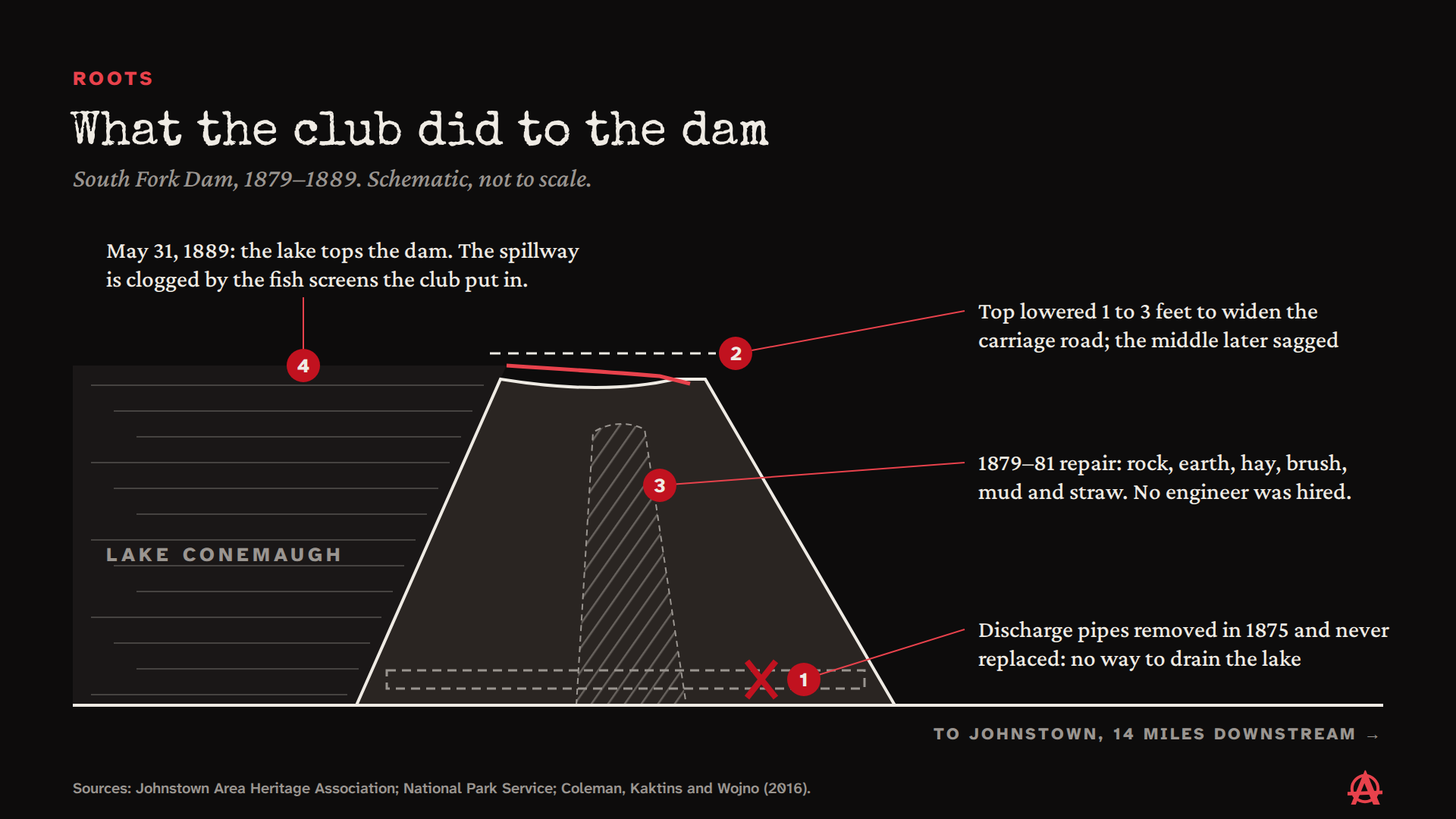
The warnings. In November 1880, John Fulton, an engineer for the Cambria Iron Company, inspected the dam and reported "two serious elements of danger": no discharge pipes, and an "unsubstantial method of repair, leaving a large leak." Ruff answered: "You and your people are in no danger from our enterprise." Cambria's president, Daniel Morrell, wrote that the dam was "a perpetual menace to the lives and property" of the valley and offered to help pay to make it safe. The club declined. In Johnstown, people joked about it. As one survivor remembered the town's attitude: "Sometime, that dam will give way, but it won't ever happen to us."
The town below. Johnstown was a company town on a floodplain where two rivers meet. Cambria Iron, a fifty-million-dollar steel works, employed about six thousand men, many of them Welsh, German, Irish, Scottish, Swedish and Hungarian immigrants. The company fired anyone who joined a union, and its workers lived in cheap frame houses on the low flats by the river while the managers lived higher up.
May 31, 1889. A storm dropped six to ten inches of rain on the region in a day. By morning the lake was rising almost a foot an hour. The club's president, E. J. Unger, put a crew of laborers to work trying to raise the crest and open the spillway, but the fish screens were clogged with debris. Telegraph warnings went down the valley: at 1:52 p.m., "water is running over the breast of lake dam"; at 2:45, it "may possibly go." Around 3:10 the dam gave way. The lake emptied into the valley in well under an hour. The wave picked up houses, trees, railroad cars, barbed wire from a wire works and the people of four towns along the way. It reached Johnstown at 4:07 p.m., a churning wall of debris about 35 to 40 feet high, and destroyed the town in about ten minutes.
The night. Wreckage piled up against the railroad's Stone Bridge below town, a mass of debris covering 30 acres, with hundreds of people trapped inside it. Around six o'clock it caught fire. About 80 people died there. When the count was done, 2,209 people were dead: 99 entire families, 396 children, and 777 people who were never identified and lie in the Plot of the Unknown at Grandview Cemetery. Clara Barton arrived with the new American Red Cross on June 5 and stayed five months. It was the Red Cross's first major disaster relief effort.
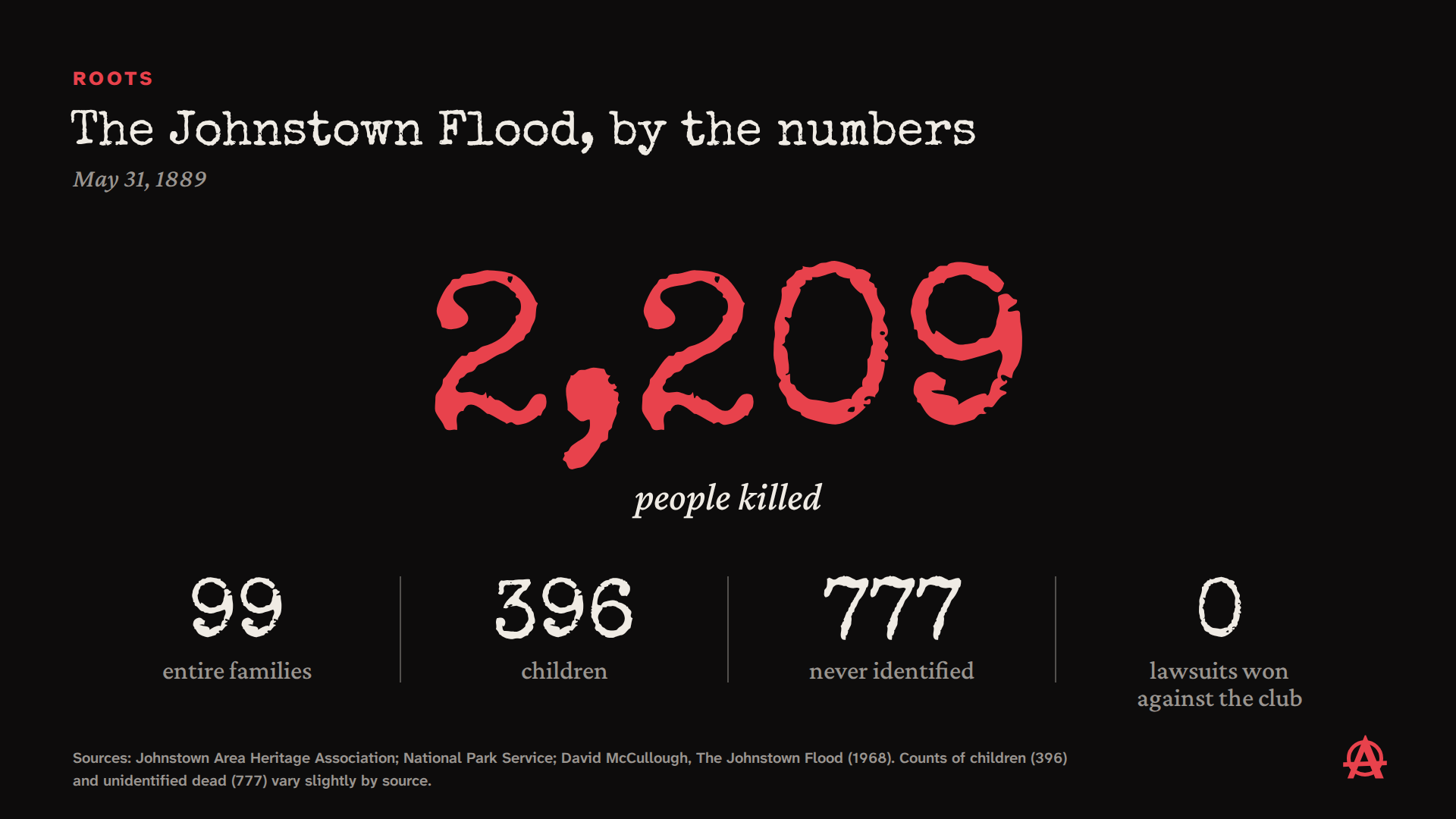
An act of God. Survivors and newspapers blamed the club at once. "We think we know what struck us," wrote the Johnstown Tribune, "and it was not the hand of Providence. Our misery is the work of man." The club's lawyers, Philander Knox and James H. Reed (no relation to the poet), were both members. They argued that the flood was an act of God. Every lawsuit against the club failed or was dropped: the club had few assets, and the courts of the time required proof that particular members had been negligent. Some members gave generously to relief; Carnegie rebuilt the town library, which now houses the Johnstown Flood Museum. No member paid a penny in damages. The legal scholar Jed Shugerman argues that outrage over Johnstown helped push American courts toward "strict liability," the rule that whoever stores something dangerous on their land is responsible when it escapes, whether or not anyone can prove negligence.
What's still argued. An 1891 report by the American Society of Civil Engineers concluded that the storm was so extreme the dam would have failed even in its original condition. The report's authors had ties to the railroad and the club's members, and a 2016 engineering study using modern hydrology disagreed: a properly rebuilt dam, with its pipes and original height, would probably not have overtopped. The storm was real. The floodplain was real. Clear-cut hillsides and narrowed river channels made Johnstown flood almost every year. Even some of the club's own members lost family. Cyrus Elder, Cambria's lawyer and a member, lost his wife and daughter, and said that if anyone was to blame, "we ourselves are among them."
What the song changes, and why
- One stanza. Reed's poem has three; the song uses the first, which names the dead, and repeats its "worse than Herod's awful crime" couplet as a chorus.
- "For the rich!" Reed's punchline is "fish." The song adds the word the poem implies.
- The 2,209 refrain is new, so the number is sung, not just read. It's the standard count; one man listed as dead turned up alive years later, which makes some sources say 2,208.
What it connects to
- Two Guns. Three years after Johnstown, club member Henry Clay Frick hired Pinkerton guards to break the steel strike at Homestead. The Baldwin-Felts men in Matewan were the same kind of private army.
- Him Hold Ye In Your Mind. The Gest's villains are rich churchmen who take land through debt. Johnstown's are rich sportsmen who took safety through neglect. Robin's list would know what to do with both.
- I Hight Don Quixote. Parsons wrote that whoever takes another's freedom to get what he wants puts his own freedom at risk. The club took the town's safety for its fishing. Some of its members lost their own families.
- For more numbers-first work on empire and rebellion, see Star Wars Death Math.
Sources
- Blakemore, Erin. "How America's Most Powerful Men Caused America's Deadliest Flood." HISTORY, August 11, 2017, updated March 30, 2026. https://www.history.com/articles/how-americas-most-powerful-men-caused-americas-deadliest-flood
- Fraser, Steve. "A History of Disaster Capitalism." Mother Jones, April 4, 2013 (first published by TomDispatch). https://www.motherjones.com/environment/2013/04/history-disaster-capitalism/
- Godbey, Emily. "Disaster Tourism and the Melodrama of Authenticity: Revisiting the 1889 Johnstown Flood." Pennsylvania History 73, no. 3 (2006): 273–315. https://npshistory.com/publications/jofl/ph-v73n3-2006.pdf
- Johnstown Area Heritage Association. "History of the South Fork Dam: Fishing and Hunting Club Repairs Era" (from Nathan D. Shappee, "History of Johnstown," PhD diss., University of Pittsburgh, 1940), "The Club and the Dam," and "Recipe for Disaster." Johnstown Flood Museum. https://www.heritagejohnstown.org/edusecret/flood/why/dam_club_era.html
- McAllister, Paul. "How One Fishing Club Killed 2,209 Americans and Got Away With It: Johnstown, Pennsylvania." YouTube.
- McCullough, David. The Johnstown Flood. New York: Simon and Schuster, 1968. See also McCullough, "Johnstown: Run For Your Lives!" American Heritage. https://www.americanheritage.com/johnstown-run-your-lives
- McLaurin, John J. The Story of Johnstown. Harrisburg: J. M. Place, 1890. https://archive.org/details/cu31924028863441
- National Park Service, Johnstown Flood National Memorial. "South Fork Fishing and Hunting Club," "Members of the South Fork Fishing and Hunting Club," "The South Fork Dam," and "Johnstown Flood Timeline." https://www.nps.gov/jofl/learn/historyculture/south-fork-fishing-and-hunting-club.htm
- Coleman, Neil M., Uldis Kaktins, and Stephanie Wojno. "Dam-Breach Hydrology of the Johnstown Flood of 1889: Challenging the Findings of the 1891 Investigation Report." Heliyon 2, no. 6 (2016): e00120.
- Shugerman, Jed Handelsman. "The Floodgates of Strict Liability: Bursting Reservoirs and the Adoption of Fletcher v. Rylands in the Gilded Age." Yale Law Journal 110 (2000): 333–77.
- WPSU. "The Johnstown Flood: Hubris Leads to Total Devastation." Past PA, May 17, 2023. https://www.youtube.com/watch?v=5X89yRJCR2o